Can Red Light Therapy Hurt Your Eyes? Safety Tips for Masks and Panels
Red light therapy is generally low-risk for your eyes when a device is well made and used as directed. It is not risk-free, though. Bright LEDs held close to the face can strain the eyes, and habits like staring into a panel or running long sessions make problems more likely. This guide to red light therapy eye safety explains how red and near-infrared light reach the eye, what the research says so far, and the practical steps that protect your vision with a mask or a panel.
How Red and Near-Infrared Light Reach Your Eyes
Most home devices use red light at about 630 to 660 nm and near-infrared light at about 810 to 850 nm. Red Light Rise devices, for example, are built around 660 nm red and 850 nm near-infrared. Neither range is ultraviolet, the type of light linked to sunburn and cataracts. Two details still matter for eye safety.
Near-Infrared Light Is Mostly Invisible
You can’t really see near-infrared light. At most, an 850 nm LED shows a faint red glow, so your eyes get little warning. With a bright visible light, you squint or look away without thinking. With near-infrared, that protective reflex doesn’t kick in the same way, which means your eyes can take in more light than you realize.
Closed Eyelids Don’t Block Everything
Eyelids filter some light, but not all of it. Red light passes through them more easily than most other colors, and near-infrared light at 810 to 850 nm passes through even more readily. Shutting your eyes helps, but it shouldn’t be your only protection. This is why goggles are recommended for panels, where the output is stronger and covers a wider area.
What the Research Says About Red Light Therapy and Eye Safety
Red and near-infrared light are actively studied in eye care. In late 2024, the FDA authorized a clinic-based device called Valeda for people with dry age-related macular degeneration. It uses LEDs at 590, 660 and 850 nm, close to the wavelengths in many home devices, but at a controlled dose and under a doctor’s care.
There is a cautionary side too. A 2023 case report from China described a 12-year-old whose vision dropped after five months of red-light laser treatment for nearsightedness. That device sent laser light straight through the pupil to the retina. After she stopped treatment, the damage partly recovered and her vision improved. A laser aimed into the eye is very different from an LED mask resting on the skin, but the case shows why dose and direct exposure matter.
Long-term data on regular home use near the eyes is still limited. There is no strong evidence that short, protected sessions harm healthy eyes, but the absence of evidence isn’t proof of safety. Until the picture is clearer, a cautious approach costs you nothing.
The Eye Risks That Are Actually Realistic
Glare and Eye Strain
Bright LEDs at close range can tire your eyes, much like staring at a bright screen. Watch for strain, aching and headaches. These should ease once you move away from the light.
Staring Into Bright LEDs
Looking directly into an LED array, even briefly to check that it’s on, exposes the eye to concentrated light for no benefit. Use the indicator light or timer instead.
Sessions That Run Too Long or Too Close
More time and less distance mean more light reaching the eye. Manufacturers set recommended distances and session lengths for a reason, and extra minutes won’t speed up results.
Multi-Color Masks and Blue Light Mode
Some LED masks offer several colors, including blue light, which is often marketed for acne. Blue light is a different story from red and near-infrared. Safety standards like IEC 62471 rate it separately as a potential “blue light hazard” for the retina. If your mask has a blue setting, keep your eyes closed, use any eye shields that come with it, and follow the session limits for that mode specifically.
Red Light Eye Massagers: A Special Case
Eye massagers sit directly over closed eyes and usually combine gentle heat with low-power red light. Use them only as directed and for the stated session time. Don’t use them on irritated, infected or recently treated eyes. If you’ve had eye surgery, check with your doctor first.
How to Protect Your Eyes During Red Light Therapy
Wear Proper Eye Protection
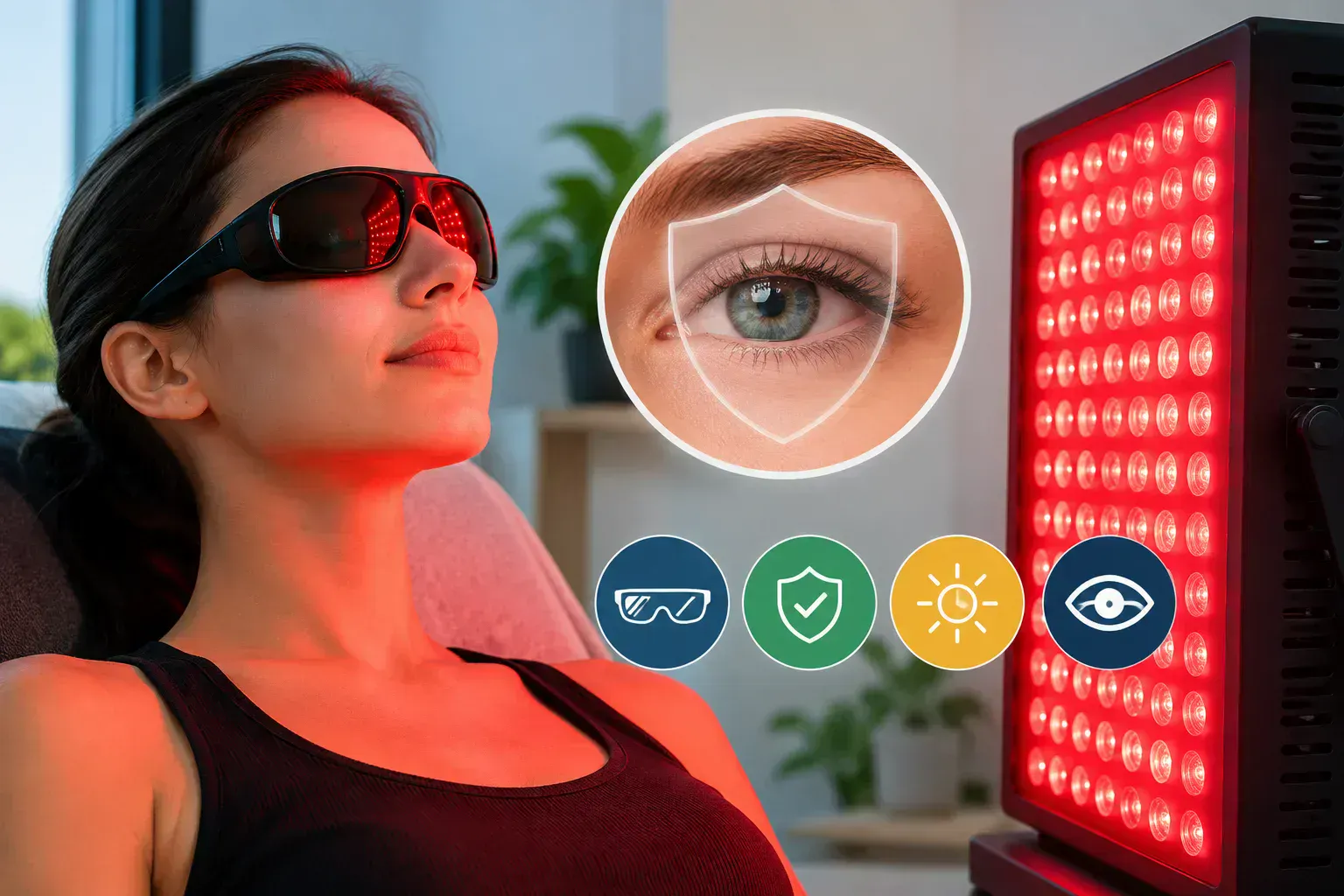
Use goggles made for red light therapy, especially with a panel, and keep your eyes closed as well. Ordinary sunglasses aren’t built for this, so use the goggles supplied with your device or a pair rated for red and near-infrared light.
Choose a Device Built for the Job
Masks are designed to sit against the face, and a good one accounts for the eye area. Panels cover more ground and need more care with distance and protection. If you’re comparing options, browse our LED face masks and red light therapy panels.
Keep to the Recommended Distance and Time
Follow the instructions for how far to sit from a panel and how long each session should last. A sturdy stand makes it easier to hold a consistent distance. You’ll find options in our panel stands and accessories collection.
[H3] Take Extra Care Around the Eye Area
Many people treat crow’s feet and the skin around the eyes with their eyes closed and protected. Check your device’s guidance for that area first. If under-eye care is your main goal, see our eye massagers and under-eye care collection and our wrinkles and anti-aging range.
| Do | Don’t |
|---|---|
| Wear goggles and close your eyes | Rely on eyelids alone |
| Follow the recommended distance and time | Extend sessions for faster results |
| Choose a device with clear specifications | Buy one with no wavelength or power details |
| Use blue-light modes with extra care | Treat every color setting the same |
| Stop if your eyes feel uncomfortable | Push through discomfort |
How to Choose a Safer Red Light Device
Check what the manufacturer actually publishes. Clear wavelength, power and recommended-distance figures are a good sign. Vague listings with no numbers are a reason for caution. Look for evidence of independent testing and recognized safety certification too. IEC 62471 is a photobiological safety standard that rates lamps by the optical radiation they emit, so a device tested to it is worth favoring. If the information isn’t on the product page, ask the seller directly.
Signs You Should Stop a Session
Stop and rest your eyes if you notice any of these: eye pain, light sensitivity, a headache during or after use, spots in your vision, or blurred vision. If any of these last more than a short time, see an eye doctor rather than waiting it out.
Who Should Speak to a Doctor First
Talk to an eye doctor or your physician before starting if you:
- have an existing eye condition or have had eye surgery
- take medication that increases light sensitivity, such as certain antibiotics or acne medicines
- have epilepsy or are sensitive to flashing light, if your device has a pulse mode
- are thinking of using a device on a child, since clinical red-light treatments for kids are carefully dosed and monitored
- are pregnant or unsure whether red light therapy suits you
With eyes involved, a quick check is cheap insurance.
Final Thoughts
Red light therapy can be used safely when you pick a device with clear specifications, protect your eyes properly and stick to the recommended settings. The habits that cause problems, like staring into the light or overdoing sessions, are easy to avoid. If you’re ready to choose a device, start with our full range of red light therapy devices.
One thought on “Can Red Light Therapy Hurt Your Eyes? Safety Tips for Masks and Panels”