Does Red Light Therapy Help Hair Growth? What the Research Shows
Yes, red light therapy can help hair growth, mainly for people with early to moderate pattern thinning who use it consistently for at least three to six months. Sham-controlled studies in both men and women with androgenetic alopecia have found measurable gains in hair count and density. It won’t regrow hair on areas that have been bald for years, and you won’t see a difference in two weeks.
That’s the short answer. If you’ve been tilting your head under the bathroom light, checking whether your part looks wider than it used to, it’s worth understanding why it works and where it falls short before you spend money on a device.
What Is Red Light Therapy for Hair?
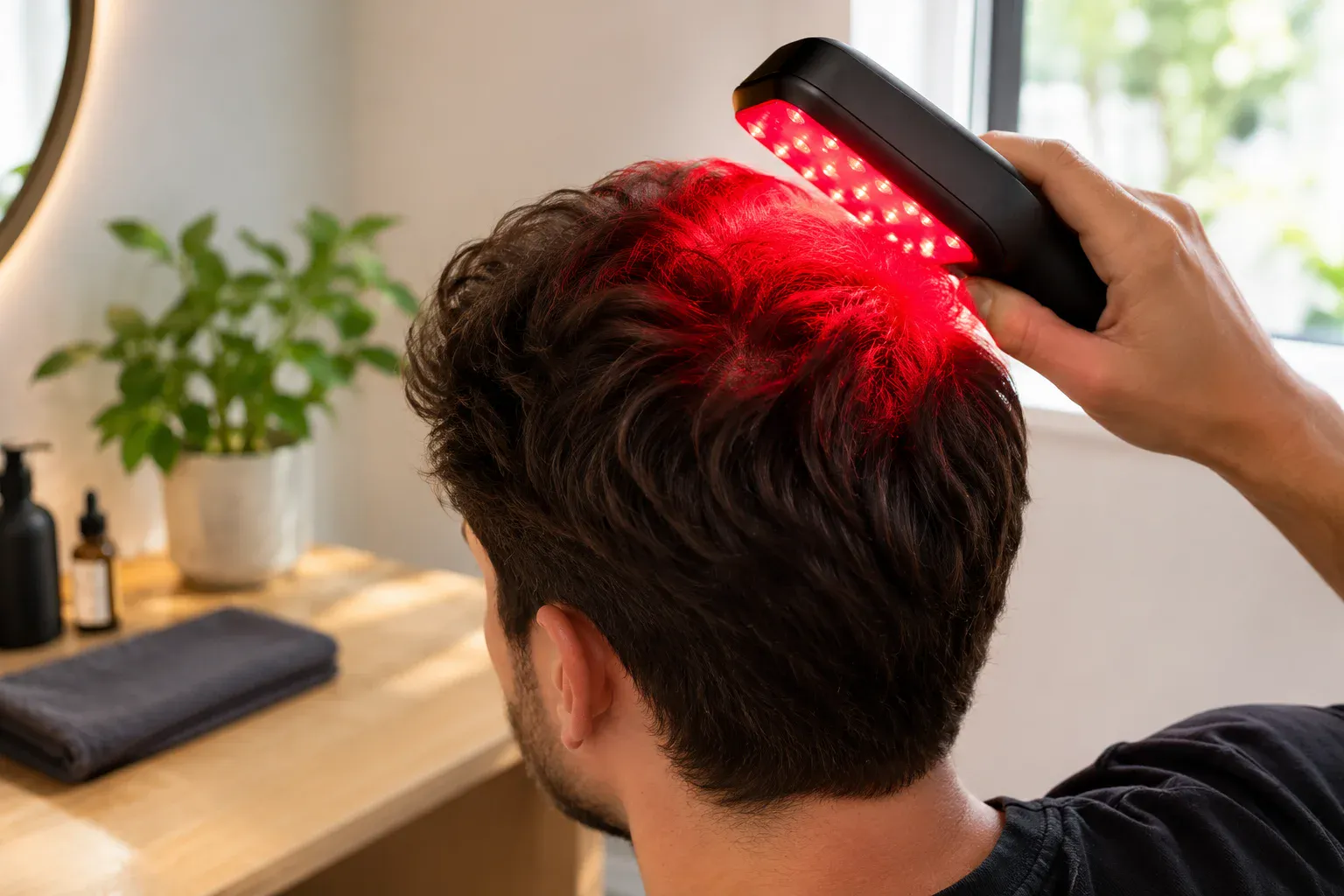
Red light therapy, also called photobiomodulation or low-level light therapy (LLLT), uses red and near-infrared wavelengths to reach the scalp and the follicles beneath it. The light comes from either low-power laser diodes or LEDs, built into caps, helmets, combs, and brushes.
It isn’t the same type of laser used for hair removal or skin resurfacing. There’s no UV, nothing gets burned, and at most you’ll feel mild warmth during a session. It’s low-risk and doesn’t require a prescription, which is a big part of why it has become so popular.
The same wavelengths are used well beyond the scalp. If you’re curious how they’re applied elsewhere, see how people use red light therapy for pain relief and recovery on muscles and joints.
How Does Red Light Therapy Work on Hair Follicles?
“It stimulates cells” isn’t a real explanation, so here’s the actual mechanism.
Hair follicles are packed with mitochondria, the structures that produce energy inside your cells in the form of ATP. When red or near-infrared light reaches the scalp, an enzyme in the mitochondria called cytochrome c oxidase absorbs it, which boosts ATP production. That extra energy at the follicle level appears to help in three ways.
Better Blood Flow Around the Follicle
Improved circulation means more oxygen and nutrients reach the follicle, which supports healthier, more active growth.
Less Inflammation at the Root
Pattern hair loss is driven mainly by genetics and DHT, a hormone that gradually shrinks sensitive follicles. Low-grade inflammation around the follicle is also thought to play a role, and red light may help calm it.
A Longer Growth Phase
Hair grows in cycles, and the active growing stage is called the anagen phase. Red light appears to keep follicles in this phase longer, so strands grow longer and thicker before they shed.
What Red Light Can’t Do
It can’t revive a follicle that is scarred or has been shut down for years. A lot of marketing glosses over this, so it’s worth saying plainly. Red light works on follicles that are shrinking, stressed, or slowing down, not ones that are gone.
What Does the Research Actually Show?
One of the most cited studies is a 2014 multicenter, randomized, double-blind trial published in the American Journal of Clinical Dermatology. Researchers screened 146 men and 188 women with pattern hair loss and compared an FDA-cleared laser comb against an identical-looking sham device over 26 weeks. The real device produced significantly greater increases in terminal hair density in both men and women, and more users reported thicker, fuller hair.
Separate sham-controlled trials by Lanzafame and colleagues tested a 655nm helmet in men and in women over 16 weeks and also found significantly higher hair counts compared to sham. A 2020 review of controlled trials reported that every sham-controlled study it examined showed a statistically significant increase in hair density or thickness.
The research does have limits. Many trials were small, short-term, and funded by device makers, and most tested laser devices rather than LEDs. The results are consistent, but long-term data is still thin.
| Who’s Using It | Study Design | Time Frame | What Researchers Reported |
|---|---|---|---|
| Women with pattern hair loss | Randomized, sham-controlled | 16 to 26 weeks | Higher hair density and count |
| Men with androgenetic alopecia | Randomized, sham-controlled | 16 to 26 weeks | Increased hair count |
| Early or mild thinning | Smaller trials, observational data | 12 to 24 weeks | Slower shedding, thicker-feeling hair |
| Long-term bald areas | Barely studied | Not applicable | Little to no expected change |
Two patterns show up across this research. Results take three to six months, not weeks. And the people who saw a difference used their device consistently, not perfectly, but regularly. That’s why dermatologists usually treat red light as a supporting option alongside good scalp care, and sometimes minoxidil, rather than a standalone cure.
Who Gets the Best Results From Red Light Therapy?
Based on the research, red light therapy for hair growth tends to work best for:
- People who catch pattern thinning early, while follicles are shrinking but still active.
- Women with crown thinning or a widening part, one of the most common female pattern hair loss patterns.
- Anyone with shedding linked to stress, illness, or a rough stretch that slowed the hair cycle down.
- People who mainly want existing hair to feel thicker, rather than regrowing a spot that’s been bald for a decade.
If an area has been smooth and hairless for years, a device probably won’t change much there. That’s a conversation for a dermatologist.
How to Use Red Light Therapy for Hair Growth
Results come down to three things: the right wavelength, light actually reaching your scalp, and consistency.
Choose the Right Wavelength
Red light in the 630 to 670nm range is the most studied for hair. Near-infrared light at 810 to 850nm penetrates deeper, and many devices combine both, though research on near-infrared specifically for hair is less extensive.
Make Sure the Light Reaches Your Scalp
Hair blocks light much the way fabric does, which we explain in our guide on whether red light therapy works through clothes. Start with a clean, dry scalp and skip heavy oils or styling products before a session so nothing sits between the light and your skin.
Stick to a Consistent Schedule
Studied protocols vary by device. Most run three to four sessions a week, or every other day, with sessions ranging from a few minutes to around 25 minutes. Follow your device’s instructions, since more time doesn’t mean faster results.
Pick a Format You’ll Actually Use
Coverage matters more than most people expect. A handheld comb sounds fine until you’re trying to move it evenly across your whole scalp every session, and many people quietly stop doing it properly after a few weeks. Caps cover the full scalp hands-free, so they tend to get used more consistently. Our red light therapy hair growth devices include full-coverage caps as well as scalp combs and brushes for targeted areas.
| Device Type | Coverage | Best For | Main Drawback |
|---|---|---|---|
| Red light cap or helmet | Full scalp, hands-free | Overall thinning, busy routines | Higher upfront cost |
| Scalp comb or brush | One section at a time | Thick hair, targeted spots | Tedious to cover the whole scalp |
How Long Does Red Light Therapy Take to Work for Hair?
Hair grows in cycles, so changes take time to show. Here’s a realistic timeline with consistent use:
| Time Frame | What to Expect |
|---|---|
| Weeks 1 to 4 | No visible change; this is normal |
| Weeks 4 to 8 | Shedding often starts to slow |
| Weeks 12 to 16 | Early changes in thickness may appear |
| Months 4 to 6 | Visible density improvements for responders |
Take a photo of your part line once a month in the same lighting and from the same angle. Less hair in the shower drain is usually the first sign something is happening, well before you notice it in the mirror.
Is Red Light Therapy Safe for Your Scalp?
Red light therapy is one of the lower-risk options for hair loss. There’s no UV and no systemic side effects like some oral medications. Some people notice mild warmth, dryness, or scalp tenderness. Use eye protection if the device sits close to your eyes, and see our guide on red light therapy eye safety for more detail.
Talk to a dermatologist first if your hair loss is sudden, patchy, or comes with itching or pain, since conditions like alopecia areata, thyroid issues, or low iron need a proper diagnosis. The same applies if you take photosensitizing medication or have a scalp condition like psoriasis.
The Bottom Line
Red light therapy for hair growth is backed by real, sham-controlled research, not just marketing. It can slow shedding and improve density, especially when pattern thinning is caught early. It isn’t fast and won’t work for everyone, but used consistently for a few months, it’s one of the better-supported drug-free options you can use at home.